Quick Navigation
- So, What Exactly Is Moonstone?
- Where Does It Come From? The Geology Behind the Glow
- A Rainbow in the Moonlight: Colors and Varieties
- Meaning and Properties: The Spiritual and the Physical
- How to Spot a Real Moonstone (And Avoid Fakes)
- Buying Moonstone: A Step-by-Step Decision Guide
- Caring for Your Moonstone
- Your Moonstone Questions, Answered
Let's be real. You've probably seen moonstone pop up all over your social media feed or in that trendy crystal shop downtown. It's got this otherworldly shimmer that makes you stop and stare. But what is it, really? Is it just another pretty rock, or is there something more to it? I remember the first time I held a good quality piece. I turned it over in my hand, watching the blue-white light dance across its surface like a tiny, captured moonbeam. It was nothing like the flat, dull beads I'd seen before. That's when I got curious.
This guide isn't about throwing spiritual jargon at you. It's for anyone who's looked at a moonstone and wondered what makes it tick. Whether you're thinking of buying one, you're into geology, or you just love beautiful things, we're going to dig into everything. And I mean everything—from how it's formed deep in the earth to why some people swear by its calming vibes, and how to avoid getting ripped off when you're shopping for one.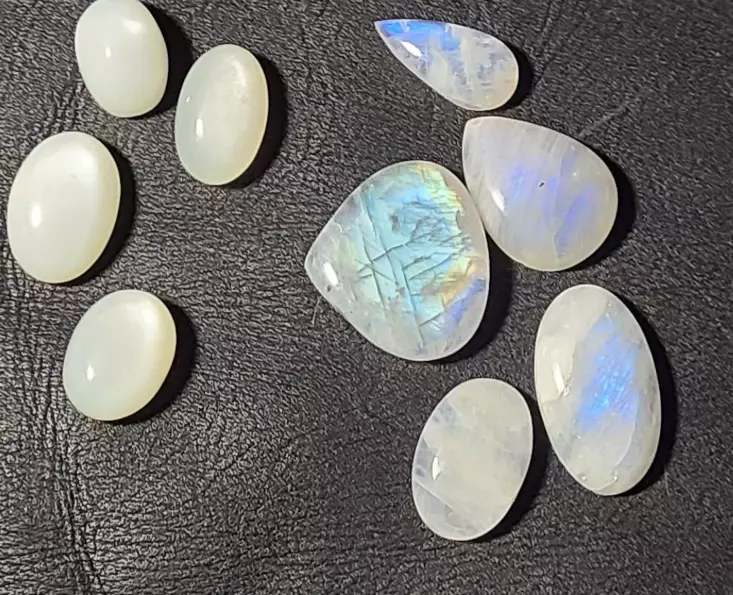
So, What Exactly Is Moonstone?
At its core, moonstone is a mineral. Specifically, it's a variety of orthoclase feldspar (sometimes called potassium feldspar). The magic—that famous glow—has a scientific name: adularescence. It's not just a fancy word; it's the key to the whole show. This effect happens because of the stone's internal structure. Imagine it like a stack of super-thin, alternating layers of two different types of feldspar (orthoclase and albite). Light enters the stone, bounces between these layers, and scatters. This scattering creates that soft, billowy light that seems to float just under the surface. It's an optical illusion of depth and light.
The quality of this adularescence is what separates a mediocre moonstone from a stunning one. A weak glow looks milky and flat. A strong one looks like you're peering into a misty, moonlit cloud. The best stones have a sharp, blue sheen that rolls across the surface as you move it. It's mesmerizing.
And here's a bit of trivia that often gets missed. That term "adularescence" comes from Adularia, which is an old name for a specific type of high-quality, transparent orthoclase found near Mt. Adular in Switzerland (now the Gotthard Massif). So, in a way, the name itself is a nod to its classic, high-quality origin. You can read more about the mineralogical specifics of feldspar on the Mindat page for Orthoclase, which is a fantastic, community-run resource for mineral data.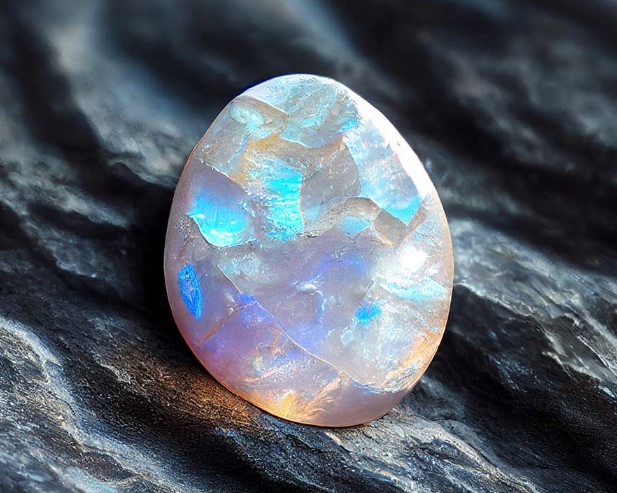
Where Does It Come From? The Geology Behind the Glow
You don't just find moonstone lying around everywhere. It needs very specific conditions to form. We're talking about magma cooling slowly deep underground, allowing those perfect alternating layers of feldspar to crystallize in just the right way. It's a slow, precise geological dance.
The classic source, the one that set the standard for centuries, is Sri Lanka (formerly Ceylon). Sri Lankan moonstones are famous for their almost transparent body with a sharp, blue adularescence. They're the benchmark. But they're not the only game in town anymore.
India produces a huge amount of moonstone, often with a more opaque, milky-white or peach body and a softer sheen. It's beautiful in its own right and is the type you'll commonly find in more affordable jewelry. Then there's Madagascar, which produces some lovely material that can rival Sri Lankan stones. Other sources include Myanmar, Tanzania, and even the United States (like in Virginia).
I have a small, rough moonstone from India that's more cloudy than clear, but the sheen is a soft peach color. It's completely different from my Sri Lankan cabochon, which is like looking into clear water with a blue ghost inside. Neither is "better"—they're just different expressions of the same phenomenon.
| Major Source | Typical Color & Body | Adularescence Quality | Common Use |
|---|---|---|---|
| Sri Lanka | Near-colorless to pale gray, semi-transparent | Strong, sharp, often blue | High-end jewelry, collector pieces |
| India | White, peach, gray, more opaque | Softer, more diffused, can be blue or white | Mass-market jewelry, beads, carvings |
| Madagascar | Colorless to pale brown, semi-transparent | Can be very strong and blue, similar to Sri Lankan | Jewelry, collector specimens |
| United States | Varied, often with inclusions | Variable, often weaker | Local jewelry, mineral specimens |
It's worth noting that the geology of each location impacts the final product. The impurities, the cooling history, the pressure—all of it plays a part in the color and strength of the sheen you see in a finished piece of moonstone.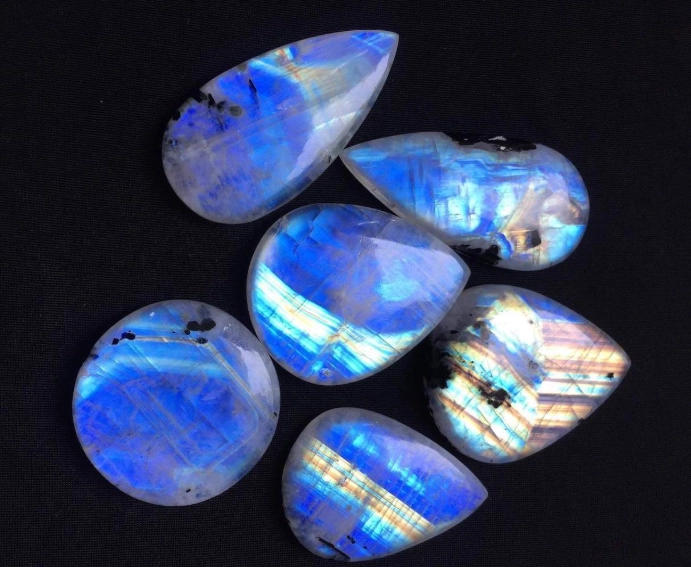
A Rainbow in the Moonlight: Colors and Varieties
If you think moonstone is just white, you're in for a surprise. That adularescence can play over a range of body colors, creating different moods and feels.
- Classic White/Rainbow Moonstone: This is the most common. The body is milky white, and the sheen can be white, silver, or display a rainbow of colors. A quick note: what the gem trade often calls "rainbow moonstone" is actually a different variety of feldspar (usually labradorite or another plagioclase) that shows flashes of color. It's beautiful and often sold as moonstone, but purists will note the technical difference. The Gemological Institute of America (GIA) Gem Encyclopedia is a great place to see the official definitions and comparisons.
- Peach Moonstone: Has a warm, peachy-orange body color. The sheen is usually a softer silver or blue. It feels very gentle and nurturing.
- Gray Moonstone: A smoky gray body that makes the blue adularescence really pop. It looks more mysterious and sophisticated to me.
- Green Moonstone: Rarer, with a subtle greenish body. It's quite sought after.
- Cat's Eye Moonstone: This is a chatoyant variety, meaning it has a single, sharp band of light that moves like a cat's eye. It's much rarer than the standard adularescent type.
The color you're drawn to is a personal thing. I lean towards the grays and the classic blues. The peach ones are lovely, but they sometimes remind me of a sunset more than the moon, which defeats the vibe I'm after. See? Personal opinion already.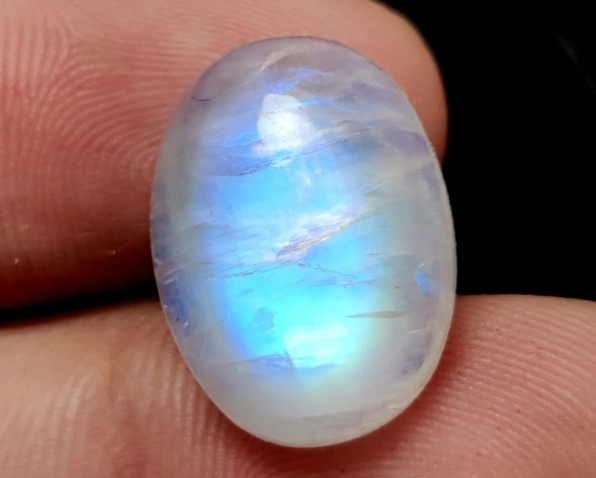
Meaning and Properties: The Spiritual and the Physical
Okay, let's talk about the elephant in the room. Moonstone is huge in the crystal healing and metaphysical world. It's often called the "Stone of New Beginnings" and is deeply tied to the feminine, intuition, and emotional balance. People use it for calming anxiety, enhancing creativity, and connecting with their inner cycles. It's a staple for anyone interested in that side of things.
But let's separate the folklore from the physical for a second. Whether you believe in the energetic properties or not, there's no denying the psychological effect of holding something so serene and beautiful. It forces you to slow down and look closely. That act alone can be calming. I keep a small tumbled moonstone on my desk. When I'm feeling scattered, I'll just roll it around in my palm. It's a tactile reminder to pause. Does the stone itself have magic? I don't know. But the ritual of using it as a focus point certainly helps me.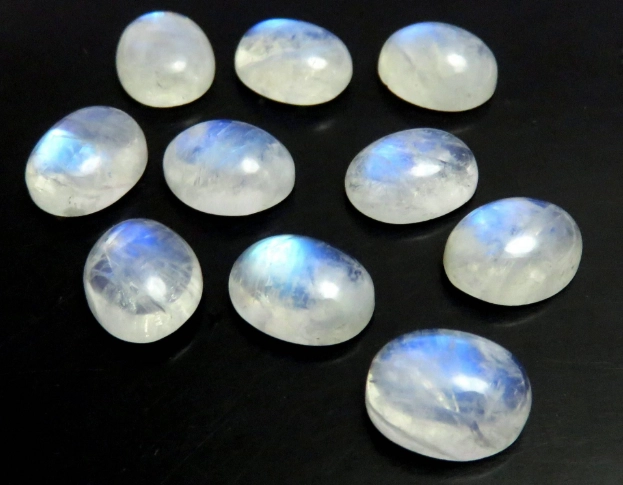
On the purely physical side, moonstone has some practical characteristics you should know if you plan to wear it.
- Durability: It's a 6 to 6.5 on the Mohs scale of hardness. This means it's softer than quartz (7). It can be scratched by everyday dust (which contains quartz particles) and is susceptible to chips and cracks if knocked hard. This is crucial for jewelry.
- Care: Because of its perfect cleavage (a tendency to split along flat planes), it can split if struck at the wrong angle. Ultrasonic cleaners and steam cleaners are a big NO. Warm, soapy water and a soft brush are the way to go.
- Sensitivity: It doesn't like sudden temperature changes or harsh chemicals. Take it off before cleaning, swimming, or going to the gym.
How to Spot a Real Moonstone (And Avoid Fakes)
This is where things get practical. Not everything that glitters is moonstone. Here’s what to look for:
- The Sheen Moves: The adularescence should appear to float under the surface. It rolls as you rotate the stone. If the shine is stuck on top (like a coating) or looks sparkly and point-based (like glitter), it's not right. Imitations like opalite glass have a fixed, milky glow that doesn't move in the same way.
- Check the Temperature: Real stone feels cool to the touch and takes a moment to warm up. Glass or plastic will feel closer to room temperature faster.
- Look for Imperfections: Most natural moonstones have minor inclusions, tiny cracks, or a slightly uneven body color. A perfectly flawless, cheap stone is a red flag.
- Ask for Details: A reputable seller should be able to tell you the source (e.g., Sri Lanka, India) and whether it's natural. Be wary of terms like "man-made" or "simulated" unless that's what you want.
Buying Moonstone: A Step-by-Step Decision Guide
Ready to get one? Don't just click "add to cart." Think it through.
First, decide on your budget and purpose. Are you buying a statement ring you'll wear often, or a small pendant for occasional wear? A daily-wear ring needs a more durable setting (like a bezel) and you should be prepared for it to get scratched over time—it's just the nature of the stone. A pendant is more protected.
Second, prioritize the adularescence. In my opinion, the quality of the glow is more important than perfect clarity. A stone with a few inclusions but a fantastic, rolling blue sheen is worth more than a flawless, dull one. Ask the seller for a video taken in natural light.
Third, consider the cut. Moonstone is almost always cut "en cabochon"—that smooth, domed shape with no facets. This maximizes the adularescence. The dome should be nice and high, not flat. The back of the stone is often left unpolished or slightly hollowed out to let more light in and make the sheen brighter.
Fourth, think about the setting. Silver is the classic choice—it complements the cool tones of the blue sheen beautifully. But rose gold with a peach moonstone is a stunning, modern combo. Make sure the setting protects the stone's edges (bezel or partial bezel is great) because of that cleavage issue.
I made a mistake with my first moonstone ring. I bought it in a cheap, prong setting because it was pretty. Within a year, one of the prongs snagged, and the stone got a nasty chip on the girdle. Now I only buy moonstones in protective settings. Lesson learned.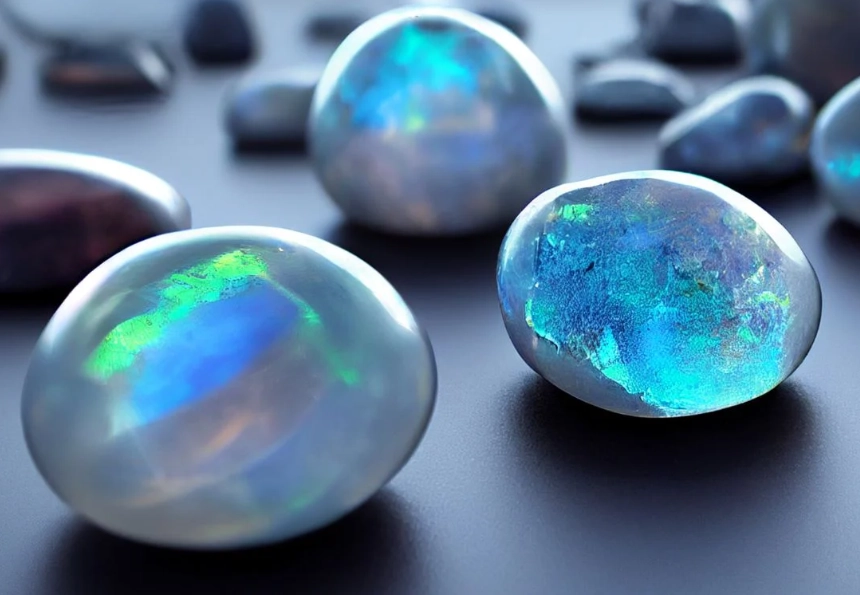
Caring for Your Moonstone
If you want your moonstone to keep its magic, you've got to baby it a little. Here's the simple routine:
- Store it alone in a soft pouch or a separate compartment in your jewelry box. It can be scratched by harder gems.
- Clean it gently with lukewarm water, mild dish soap, and a soft toothbrush. Rinse and pat dry with a soft cloth.
- Put it on last when getting dressed. Keep it away from perfumes, hairsprays, and lotions.
- Take it off for physical activities, cleaning, showering, or swimming.
It's not a stone you can forget about on your nightstand. A little care goes a long way in preserving that beautiful glow. Think of it like caring for a silk blouse instead of a cotton t-shirt.
Your Moonstone Questions, Answered
I get asked a lot of the same things. Here are the straight answers.
Is moonstone a birthstone?
Yes! It's one of the modern birthstones for June, alongside pearl and alexandrite. So it makes a fantastic personalized gift for a June baby.
Can moonstone get wet?
Brief exposure to water (like washing your hands) is fine. Prolonged soaking, especially in chlorinated or salt water, is not recommended. It's not that it will dissolve, but chemicals and salts can dull the surface over time, and the setting could be damaged.
What's the difference between moonstone and opal?
They're completely different minerals. Opal's play-of-color is caused by tiny spheres of silica diffracting light, creating flashes of spectral color. Moonstone's adularescence is caused by light scattering between layers, creating a softer, more uniform sheen that's usually blue or white. Opal is also more fragile and porous.
Is moonstone expensive?
It can range from very affordable to quite expensive. A small, commercial-grade Indian moonstone bead might cost a few dollars. A fine, large, blue-sheen Sri Lankan cabochon set in a gold ring could cost several hundred or even thousands. You pay for size, quality of the adularescence, body transparency, and origin.
How can I tell if my moonstone is high quality?
Look for three things: 1) Strength of Sheen: A bright, obvious glow that covers a good portion of the stone. 2) Color of Sheen: Blue is traditionally most valued, followed by silver-white. 3) Body Transparency: The more transparent (less milky) the body, the more dramatic the sheen appears. A stone that combines a transparent body with a strong blue sheen is top-tier.
Look, at the end of the day, moonstone is a connection point. For some, it's a connection to geology, to the immense time and pressure it takes to create something so delicate-looking. For others, it's a connection to a sense of calm or intuition. And for many, it's simply a connection to beauty—to owning a little piece of captured light that looks different every time you see it.
That's the real magic. It's not a static gem. It changes with the light, with your movement, with your perspective. It asks you to pay attention. And in a world that's always rushing, that might be the most valuable property of all.
Whether you're buying your first piece or adding to a collection, I hope this guide gives you the confidence to choose a moonstone that truly speaks to you. One that you'll keep turning in your hand, watching the glow roll across its surface, for years to come.