In This Guide
- Where Does This Magic Come From? The Geology of Fire
- What Determines the Value of a Black Fire Opal? (It's Not Just Size)
- Buying a Black Fire Opal: A Real-World Guide (Not a Textbook)
- Caring for Your Pocket Volcano: It's Fragile!
- Black Fire Opal Meaning and Myths: Beyond the Sparkle
- Your Black Fire Opal Questions, Answered
- The Final Spark
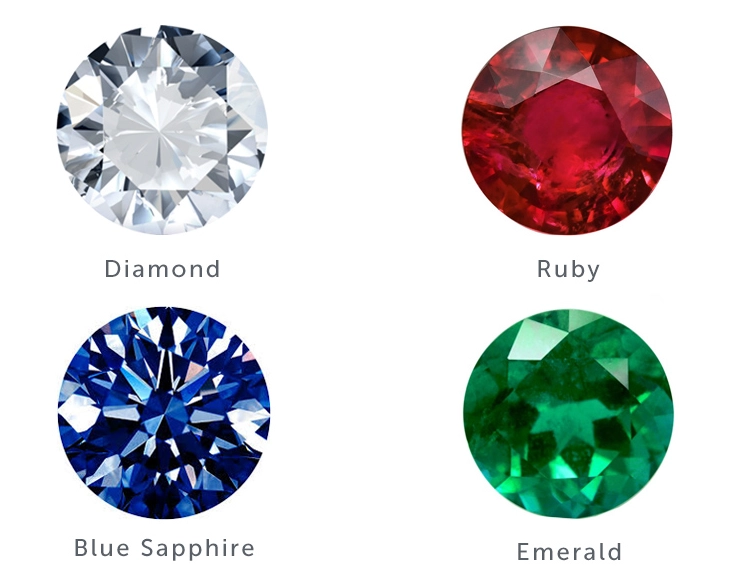
Let's be honest. Most gemstones are beautiful, sure. A deep blue sapphire, a vibrant ruby – they're classic. But have you ever held a stone that looks like it's actively on fire? Not a static color, but a living, dancing flame trapped inside a dark, mysterious body? That's the magic, and the absolute obsession, surrounding the black fire opal.
It's not just another pretty rock. It's a geological paradox. A stone born from water in the heart of ancient, dry landscapes. A dark base that somehow erupts with the most impossible colors. I remember the first time I saw a high-quality specimen in a dealer's case in Tucson. It was a modest-sized cabochon, but when the light hit it, a burst of electric red and orange swirled across its surface. I was mesmerized. And then I saw the price tag. Let's just say it was a good thing I was sitting down.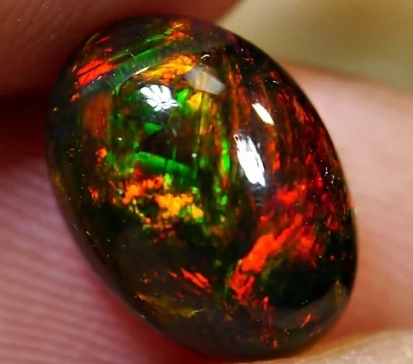
That experience is what this guide is about. We're going to move past the basic "it's pretty" and dive into what makes a black fire opal tick. What makes one worth a few hundred dollars and another worth a down payment on a house? How do you even know you're getting the real deal and not a clever imitation? Whether you're a curious admirer, a potential buyer, or someone who just inherited a piece and wants to know more, I want to give you the straight talk. No fluff, no overly technical jargon just for the sake of it. Just the practical, sometimes frustrating, always fascinating details about one of nature's most incredible performances.
So, what exactly is it? In simple terms, a black fire opal is a type of precious opal characterized by a dark body tone (ranging from dark gray to jet black) that displays a vibrant "play-of-color." This play-of-color is the fiery spectacle of reds, oranges, yellows, and sometimes greens that seems to float on its surface. The "fire" isn't a reflection; it's an internal light show caused by the diffraction of light through microscopic silica spheres stacked within the stone. The darker the body, the more dramatic and vivid this fire appears. It's the ultimate contrast.
Where Does This Magic Come From? The Geology of Fire
You don't find black fire opal just anywhere. Its formation is a precise, fragile recipe that went right millions of years ago. Most of the world's supply, and certainly the finest specimens, come from one place: Lightning Ridge in New South Wales, Australia. This remote mining town is legendary in the gem world. The conditions there were perfect – silica-rich solutions from ancient weathering volcanic rock seeped into cracks and cavities in an ironstone-rich environment. As the water evaporated, it left behind layers of those perfect silica spheres. The dark body color, crucial for a true black fire opal, comes from traces of iron oxide and carbon trapped within this silica gel.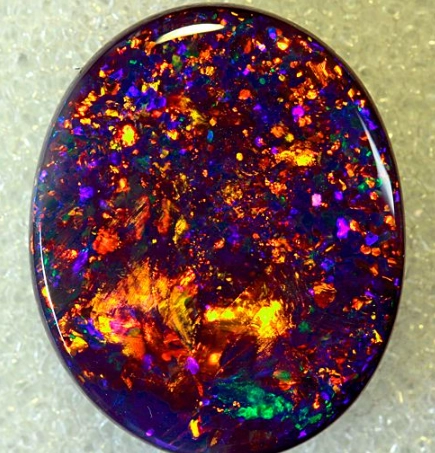
Other locations produce opal with fire, of course. Ethiopia has stunning specimens, often with a brighter, more honey-colored body tone (sometimes called "chocolate opal"). Brazil, Mexico, and the US have deposits too. But for that classic, inky-black background with intense red fire, Lightning Ridge is the undisputed king. The geology there is unique, and replicating it has proven impossible. The US Geological Survey has some fascinating public resources on how opals form in general, which helps understand the rarity of the specific conditions needed for the black variety.
Think about that the next time you see one. You're looking at a snapshot of a very specific moment in Earth's history.
What Determines the Value of a Black Fire Opal? (It's Not Just Size)
This is where most people get tripped up. With diamonds, you have the 4Cs. With black fire opal, the rules are... fuzzier, more artistic. A huge, dull stone is worth less than a small, explosive one. Here’s what you, as a buyer or admirer, need to look for, in order of importance.
The Play-of-Color: The Star of the Show
This is everything. Without fire, it's just a dark, milky stone. The quality of the fire is judged on three main factors:
- Color Range: Which colors flash? Red is the rarest and most valuable, followed by orange, then green, then blue. A stone that flashes a pure, bright red across a black body is the holy grail. Many stones show a combination, which is beautiful too.
- Brightness and Saturation: Are the colors pastel and weak, or are they vivid, electric, and intense? You want the colors to "pop" even in moderate light. Dull fire kills value.
- Pattern: How is the color distributed? Common patterns include:
- Harlequin: Large, distinct, angular patches of color like a mosaic. This is extremely rare and highly prized.
- Flash or Rolling Flash: Broad swathes of color that appear and move across the stone as you tilt it. Very desirable.
- Pinfire: Tiny, pinpoint dots of color. Common and lovely, but generally less valuable than broad flashes.
A quick personal opinion? I'd take a small stone with a brilliant rolling red flash over a large, murky stone with pinfire green any day. The impact is just in a different league.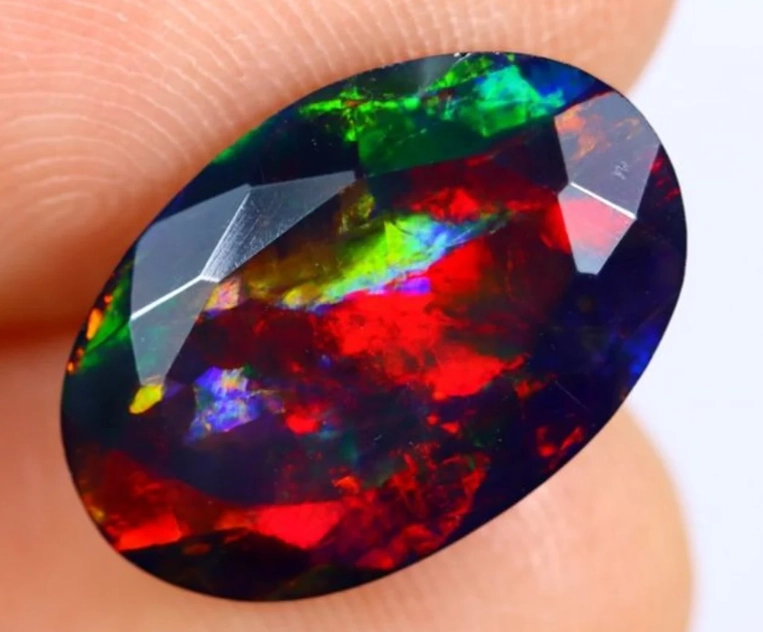
Body Tone: The Canvas
The N1 to N9 scale is used by gemologists, with N1 being jet black and N9 being light white. A true black fire opal sits in the N1 to N4 range. The darker the body, the more dramatic the color contrast, making the fire seem to float in space. A stone labeled as black opal but with a N5 or N6 (dark gray) body tone won't have the same visual punch, though it can still be stunning if the fire is strong.
Clarity, Cut, and Carat Weight
Unlike transparent gems, inclusions aren't always bad. The host rock (called "potch" or matrix) is often left on the back to protect the opal layer, creating a "boulder opal." This is normal and can create beautiful artistic effects. The cut is almost always a smooth, domed cabochon to best display the play-of-color. A good cutter will orient the stone so the fire is face-up and centered.
Carat weight matters, but it's secondary to quality. Opal is sold by the carat, but the price per carat increases exponentially with quality, not linearly with size. A 5-carat medium-quality stone may cost less per carat than a 1-carat superb stone.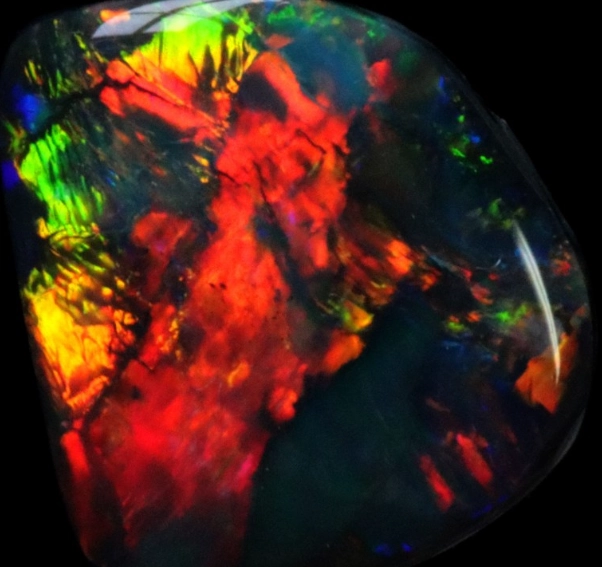
| Quality Factor | High Value Example | Lower Value Example | Why It Matters |
|---|---|---|---|
| Dominant Fire Color | Vivid, rolling red flashes | Dull, blue-green pinfire | Red is the rarest spectral color to diffract; brightness is key. |
| Body Tone | Jet black (N1-N2) | Medium gray (N5-N6) | Darkness creates maximum contrast, making fire "pop." |
| Pattern | Clear Harlequin or large Flash | Small, scattered Pinfire | Bold, organized patterns are visually striking and rare. |
| Brightness | Fire visible across a room | Fire only visible in direct light | Indicates a well-structured, high-quality internal silica lattice. |
A word of caution on treatments: Be very wary. Because of their high value, black fire opals are often treated. The most common treatment is sugar-acid or smoke treatment to darken the body tone of a lighter opal, making it look like a more valuable black opal. A reputable dealer will always disclose this. An untreated, natural black fire opal with strong color commands a significant premium. The Gemological Institute of America (GIA) has a clear overview of opal treatments that's worth reading.
Buying a Black Fire Opal: A Real-World Guide (Not a Textbook)
Okay, so you're smitten. You want one. How do you navigate buying something this subjective and potentially expensive?
First, set a budget and manage expectations. A museum-quality, red-on-black harlequin pattern stone will cost tens of thousands per carat. But you can find absolutely beautiful, wearable black fire opal jewelry with vibrant orange or multi-colored flash for a few hundred to a few thousand dollars. Start small. Get a feel for the stone.
Second, buy from a specialist. Don't buy a significant black fire opal from a generic jewelry store at the mall. Seek out reputable dealers who specialize in opals, ideally with certifications or memberships in organizations like the Australian Opal Association or who are known in the trade. Ask questions: Where is it from? Is it treated? Is it a solid stone or a doublet/triplet (a thin slice of opal glued to a black backing)? There's nothing wrong with doublets—they make the fire of a thin layer accessible—but you need to know what you're paying for.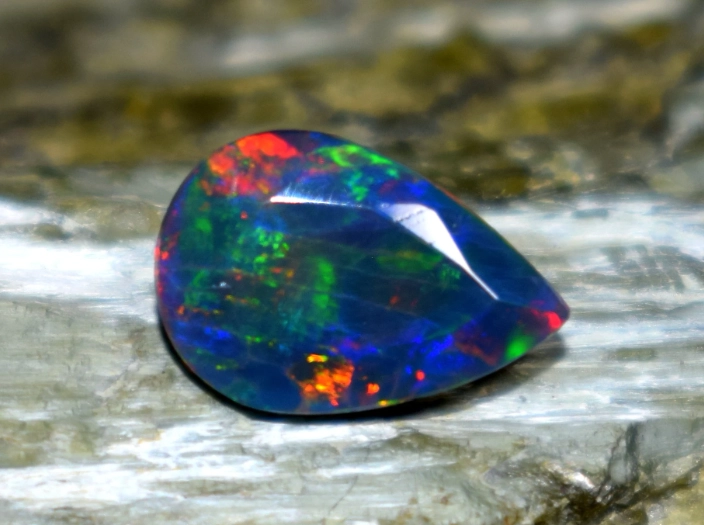
Third, see it in person, or at least via high-quality video. Photos can be massively enhanced. A good seller will provide videos showing the stone rotating under different lights. The fire should be active and visible from multiple angles, not just one sweet spot.
Trust your eyes. Does it make you say "wow"? That's the point.
Caring for Your Pocket Volcano: It's Fragile!
Here's the less glamorous part. Opal is relatively soft (5.5-6.5 on the Mohs scale) and contains water (typically 3-10%). This makes it sensitive.
Do's and Don'ts for Black Fire Opal Care
- DO store it in a soft pouch, away from harder gems that can scratch it.
- DO clean it gently with a soft, damp cloth. No steam, no ultrasonics!
- DO wear it often! The natural oils from your skin help prevent dehydration.
- DON'T expose it to sudden temperature extremes (like leaving it on a car dashboard).
- DON'T soak it in water for long periods or expose it to harsh chemicals (bleach, cleaning products).
- DON'T let it become completely dry. In very arid climates, some people even store their opals with a damp cotton ball in the pouch (not touching the stone).
Crazing – a network of tiny cracks on the surface – is a risk if the opal dries out too much or undergoes thermal shock. It's the heartbreak of opal ownership. Proper care minimizes this risk dramatically.
Black Fire Opal Meaning and Myths: Beyond the Sparkle
Every stone with this much presence gathers lore. Historically, opals were seen as both lucky and unlucky (a silly superstition largely debunked). For the black fire opal specifically, its intense energy ties it to themes of transformation, passion, and unlocking creativity. It's seen as a stone that brings hidden emotions and talents to the surface, much like its fire emerges from darkness. In some traditions, it's considered a powerful protective stone.
Do I buy into all the metaphysical claims? Not really. But I can't deny that holding a stone with such vibrant, internal life feels different than holding a static crystal. It has a personality. Whether you view that as spiritual or simply a profound aesthetic experience is up to you. The International Colored Gemstone Association (ICA) often discusses the cultural and historical significance of opal in a balanced way.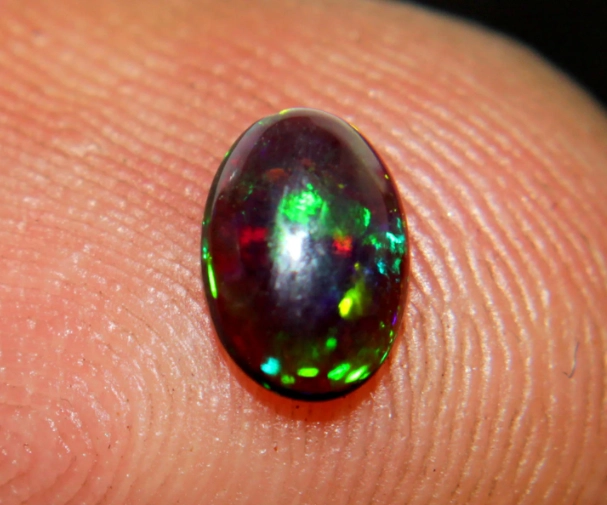
Your Black Fire Opal Questions, Answered
The Final Spark
The allure of the black fire opal isn't something you can fully capture in a guide. It's a visceral reaction. It's the shock of seeing a dark, unassuming stone suddenly come alive with a dance of color that seems to have no business being there. It represents one of nature's most precise and beautiful accidents.
If you're considering one, take your time. Learn to look past the initial dazzle and evaluate the quality factors. Find a seller you trust. And most importantly, choose a stone that speaks to you personally. Because that's what you'll be looking at for years to come – not a certificate or an appraisal, but a little piece of captured, fiery magic. Just remember to keep it away from the bathroom cleaner.
Maybe start by visiting a museum with a good mineral collection or a high-end gem show just to see some in person. Once you've seen a top-tier black fire opal under the light, you'll understand what all the fuss is about. And you might just find yourself saving up for a little volcano of your own.